
Media Liability Insurance for Social Platforms, Websites, and Online Content
If you publish content or host what your users post, you can be sued over words, images, and video. Here’s what media liability insurance covers, where cyber policies fall short, and what underwriters will ask.
A community platform gets two letters in the same week. One is from a lawyer for a local business owner who says a user’s post called him a fraud. The other is a copyright demand over music in a creator’s video. The founder checks the company’s cyber policy and finds a short section called “media liability” with wording that doesn’t mention user content at all.
Media liability insurance covers claims that content you publish or distribute caused harm, such as defamation, copyright or trademark infringement, and invasion of privacy. It’s sold as a standalone policy or as part of a cyber or Technology E&O policy. For platforms and websites, the key questions are whether it covers content your users post, not just your own, and whether exclusions for minors, adult content, or data collection take away the coverage you need most.
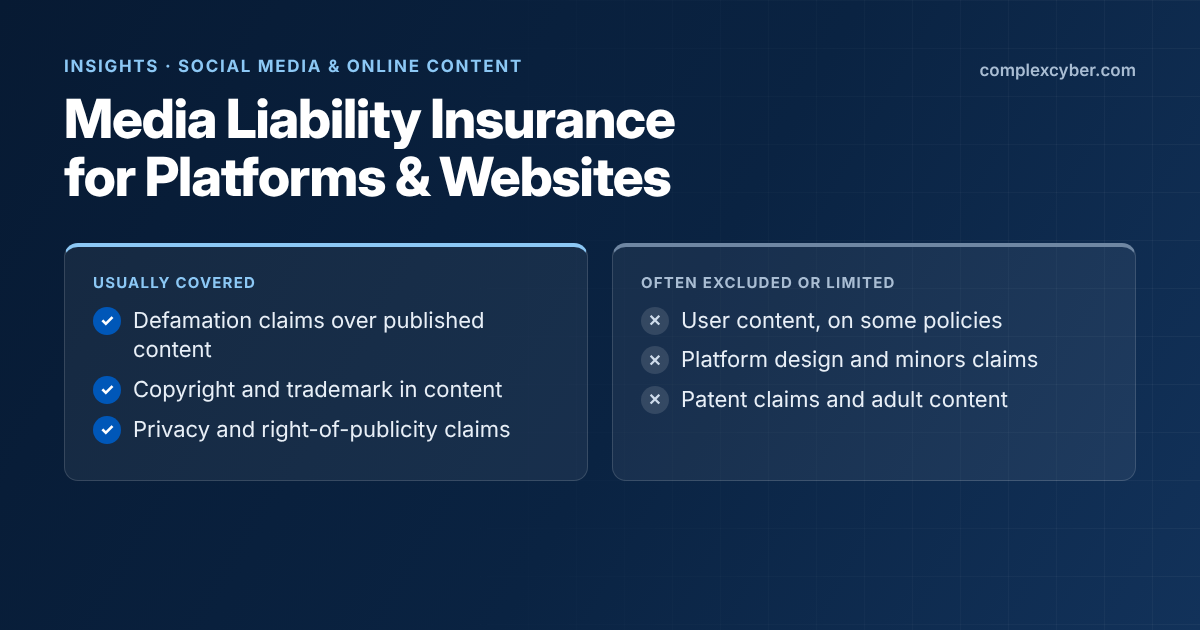
What media liability insurance covers
Media liability insurance responds when someone claims that content harmed them. The content can be an article, a video, a podcast, an ad, a social post, or a page on your website. Most policies pay defense costs plus settlements or judgments, up to the limit.
| Type of claim | Example | Where coverage usually sits |
|---|---|---|
| Defamation | A post or article says a person or business committed fraud. | Media liability policy, or the media section of a cyber policy |
| Copyright infringement | A video uses music, photos, or footage without a license. | Media liability policy or cyber media section; check how user content is treated |
| Trademark infringement | A logo, brand name, or slogan appears in content or ads without permission. | Often included in media coverage; some policies limit it |
| Invasion of privacy | Content discloses private facts or uses a person’s name or likeness without consent. | Media liability; data breach privacy claims fall under cyber instead |
| Errors in published content | Published information is wrong, and someone relies on it. | Some media policies; Tech E&O if it’s part of your service |
Patent claims are usually excluded from media liability insurance. They need separate intellectual property coverage.
Your content vs. your users’ content
Platforms face two different kinds of content risk, and policies don’t always treat them the same way.
- Content you publish: your articles, videos, podcasts, newsletters, marketing, and social accounts. Most media liability insurance is written with this content in mind.
- Content your users post: comments, reviews, videos, livestreams, messages, and listings. Some policies cover claims over user content; others exclude it or cover it only for content on your own website.
In the U.S., Section 230 of the Communications Decency Act generally protects platforms from being treated as the publisher of what their users post. That protection matters, but it doesn’t stop lawsuits from being filed, and defending even a claim you win can be expensive. Section 230 also doesn’t apply to intellectual property claims. For copyright, platforms rely on the Digital Millennium Copyright Act’s safe harbor, which requires a designated agent registered with the U.S. Copyright Office, a working takedown process, and a policy for repeat infringers. Courts and lawmakers continue to debate how far these protections reach, so insurance is still the backstop.
Where cyber policies fall short
Many cyber policies include a media liability section, and for a business with a simple website it may be enough. For platforms, publishers, and creator businesses, check for these limits:
- Only your website. Coverage may apply only to content on your own site, not apps, social accounts, podcasts, or video channels.
- No user content. Claims over content posted by users may be excluded or need an endorsement.
- Narrow claim types. Some sections cover defamation and privacy but limit copyright or trademark claims.
- Content made for others. If you create content for clients, those claims may need Tech E&O or a professional liability policy instead.
- A shared limit. Media claims can draw down the same limit you need for a breach or ransomware event.
When content is central to your business, standalone media liability insurance usually gives broader terms and its own limit.
Claims that are often excluded
- Platform design and minors. A growing number of lawsuits target how platforms are designed, especially for younger users, rather than any specific post. These claims may fall outside media coverage, and many insurers add exclusions for them.
- Adult content. Often excluded or written only by specialist markets.
- Tracking and data collection. Claims about pixels, cookies, and sharing user data with ad-tech partners usually fall under cyber privacy coverage, not media, and many cyber policies now limit them with wrongful collection exclusions or sublimits.
- Knowing or intentional infringement, contract disputes, refunds, and fines are commonly excluded.
Three common situations
A forum hosts reviews of local businesses
Defamation claims over user reviews are the main content risk. Look for media coverage that clearly includes user content, and confirm your moderation and takedown process matches what you told the insurer.
Subscribers pay for creators’ videos and posts
Copyright claims over music and footage are the frequent issue, along with privacy and right-of-publicity claims. Insurers will ask about your DMCA process, how quickly you remove content, and whether any content is adult or involves minors.
A news or media site publishes original reporting
Your own content carries the main risk, so pre-publication legal review matters to underwriters. Standalone media liability insurance with its own limit is common here, coordinated with cyber for breaches and tracking claims.
What underwriters will ask
Expect detailed questions about how content gets onto your platform and how you handle complaints:
- What kinds of content you publish, and what users can post, including livestreams and direct messages.
- Monthly active users and where your users are located.
- How you moderate content, how fast you review reports, and how you handle DMCA notices.
- Whether your own content gets legal review before publishing, and how you license music, images, and footage.
- Whether you allow adult content or users under 18, and what age and child-safety controls you use.
- What user data you collect and share with advertising partners.
- Claims, demand letters, and takedown disputes in the past five years.
Our cyber insurance application asks these questions in a social media and websites section, so one application covers your cyber, Tech E&O, and media liability needs. If you also use AI to recommend or generate content, see our guide to AI insurance.
See where your platform stands
Coverage Mapper
Choose “Social media, websites, and online content” to see your exposures, the policies that respond, and possible gaps.
Map your coverage →Cyber Insurance Application
Apply once for cyber, Tech E&O, and media liability insurance, with questions built for platforms and publishers.
Get quotes →Frequently asked questions
Does cyber insurance include media liability?
Many cyber policies include a media liability section, but it’s often limited to content on your own website and may exclude user content. Platforms and publishers usually need broader terms or a standalone policy.
Does media liability insurance cover what my users post?
It depends on the policy. Some cover claims over user-generated content, others exclude it or require an endorsement. Ask your broker to confirm before you rely on it.
If Section 230 protects my platform, do I still need media liability insurance?
Usually, yes. Section 230 doesn’t prevent lawsuits from being filed, doesn’t apply to intellectual property claims, and doesn’t protect content you publish yourself. Defense costs alone can be significant.
Is media liability insurance the same as Technology E&O?
No. Media liability insurance covers claims about content. Technology E&O covers clients’ financial losses when your technology or services fail. Many platforms need both, often alongside cyber.

Christine Marciano is the founder and president of Cyber Data Risk Managers LLC, an independent brokerage in Miami that has specialized in cyber and Technology E&O insurance since 2011. More about Christine
Run a platform, website, or content business?
We’ll review how your current policies treat your content and your users’ content, and quote media liability insurance alongside cyber and Tech E&O.
Get Quotes Request a Coverage ReviewThis article is general information, not legal advice or a statement of coverage. Coverage depends on each policy’s terms, conditions, and endorsements. Talk to your attorney about Section 230, the DMCA, and other legal protections.