
Software License Agreements and EULAs: How Liability Caps Fit Your Tech E&O and Cyber Limits
Your license agreement decides how much you could owe a customer. Your insurance decides how much of that is covered. Here’s how to line up liability caps, indemnities, and insurance requirements so the two match.
A software company sells to small businesses on a click-through EULA that caps its liability at the fees paid in the last 12 months. Then a large customer sends back redlines: liability for data breaches uncapped, an indemnity for any security incident, and proof of $5 million in Technology E&O and cyber coverage. The sales team wants to sign this week. The company’s policy has a $2 million limit.
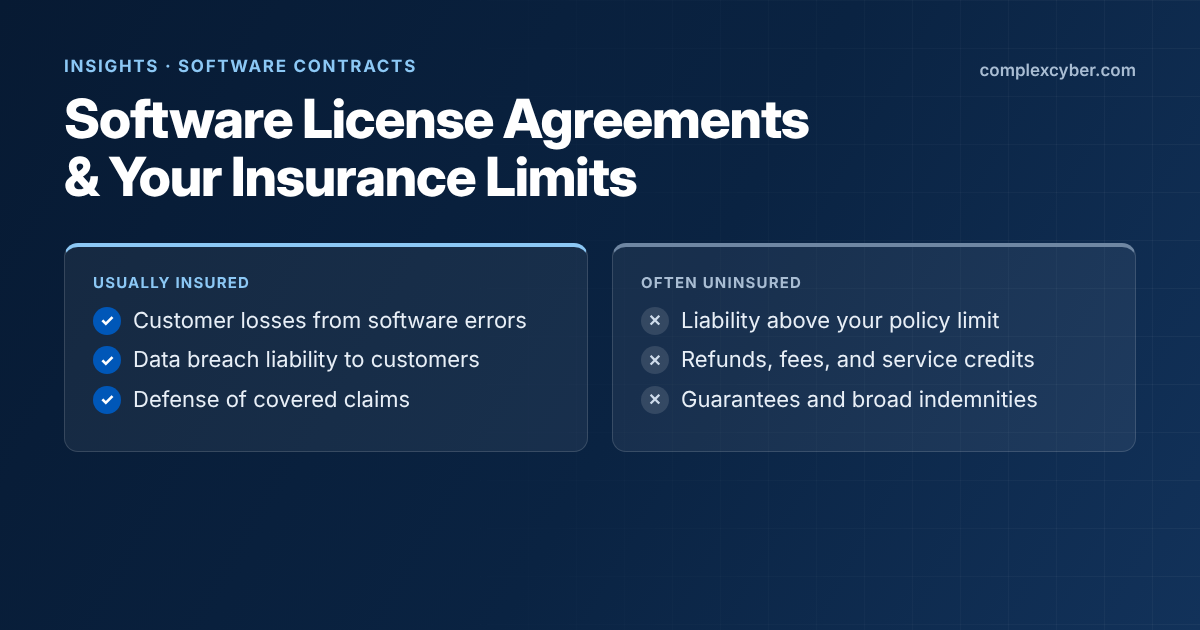
Software license agreement insurance starts with a simple rule: don’t promise more than your insurance will pay. Your license agreement or EULA sets how much you could owe a customer through its limitation of liability, indemnities, and warranties. Technology E&O covers claims that your software or services caused a customer’s financial loss, and cyber insurance covers data breach liability, but both have limits and exclusions. Liability above your limits, uncapped data breach promises, and guarantees you’ve agreed to by contract may not be insured. Have your broker review the clauses before you sign.
EULA, SaaS agreement, or MSA: which one are you signing?
- End user license agreement (EULA): your standard terms, usually click-through, for installed or downloaded software. Customers rarely negotiate them, so they tend to favor you.
- SaaS or subscription agreement: terms for cloud software. Smaller customers accept them as written; larger ones often negotiate.
- Master services agreement (MSA) with order forms: common with enterprise customers, who often send their own paper with insurance requirements, broad indemnities, and higher liability caps.
The software license agreement insurance questions are the same for all three. What changes is who wrote the terms, and how far they’ve moved from your standard position.
The clauses that decide what you could owe
| Clause | What it does | How it connects to insurance |
|---|---|---|
| Limitation of liability | Caps what you can owe, often at 12 months of fees, and excludes indirect or consequential damages. | A cap at or below your limits keeps covered claims within your insurance. A cap above them leaves the difference uninsured. |
| Carve-outs and “super caps” | Remove certain claims from the cap or give them a higher cap, often data breaches, confidentiality, and IP infringement. | Uncapped data breach liability can exceed your cyber limit. A super cap tied to your limit is easier to insure. |
| Indemnification | You agree to defend and pay the customer for certain claims, such as third-party IP or data breach claims. | Some indemnities match liability you’d have anyway; others go further and may fall under a contractual liability exclusion. |
| Warranties and service levels | Promises about performance, uptime, or accuracy, often with service credits or refunds. | Refunds, credits, and returned fees are usually not covered. Neither are guarantees beyond normal professional care. |
| Insurance requirements | Coverage types, limits, additional insured status, certificates, and notice of cancellation. | Your policy has to show these, or you’re in breach from day one. |
| Data protection terms | Security standards, breach notification timelines, and who pays breach costs. | Paying a customer’s breach response costs may need specific cyber policy wording. |
How Tech E&O and cyber respond to license claims
Technology E&O is professional liability for technology companies (see IRMI’s definition of professional liability). It responds when a customer claims your software failed, had errors, or caused them a financial loss. It’s usually the main coverage behind your license agreement.
Cyber insurance responds when data is breached. That includes your own response costs, and claims by customers and individuals whose data was exposed. For software companies, the two are often combined in one policy, sometimes with one shared limit. Our guide to cyber insurance vs. Technology E&O explains the difference.
Three gaps in software license agreement insurance catch software companies most often:
- Liability assumed by contract. Many Tech E&O policies exclude liability you take on by contract, except liability you’d have had anyway. Broad indemnities and guarantees can fall into this gap.
- Fees, refunds, and service credits. Policies usually don’t pay back what customers paid you, or the credits you promised for downtime.
- Liability above your limit. If your agreement exposes you to $10 million and your policy pays $2 million, the rest is yours. Every customer claim in the same policy period also draws down the same limit.
Software license agreement insurance: matching caps to limits
The goal is a contract you can actually back with insurance. These approaches are common in negotiations:
- Keep a general cap tied to fees, such as 12 months, for most claims.
- Offer a super cap instead of unlimited liability for data breaches and confidentiality, set at or below your cyber limit, such as “the greater of three times annual fees or $2 million.”
- Tie the super cap to insurance, for example “the limits of insurance required under this agreement,” so your exposure and your coverage move together.
- Limit indemnities to third-party claims, rather than all of the customer’s own losses.
- Avoid guarantees of error-free or uninterrupted service, and describe service credits as the customer’s sole remedy for downtime.
- Raise your limits when a customer’s requirement is reasonable and the deal is worth it. An excess layer is often less expensive than the first million of coverage.
Bring your broker in before you send redlines. It’s easier to negotiate when you know what your current program covers and what a higher limit would cost.
Three common situations
Self-serve software for small businesses
Your standard terms cap liability at fees paid and exclude consequential damages. Exposure is fairly predictable, but every customer is covered by the same aggregate limit. Make sure your limit reflects the size of your customer base and the data you hold.
The customer wants uncapped data breach liability
Offer a super cap that matches your cyber limit instead. If the customer insists on more, price an excess layer before you agree. See what a $5M insurance requirement really asks for, and whether an additional insured request can be met on cyber and Tech E&O.
Your software is licensed through a partner
Partners often ask you to indemnify them for their customers’ claims. Check that your Tech E&O covers claims that reach you through a partner, and keep the indemnity limited to claims caused by your software.
Checklist before you sign
- Compare the liability cap and every carve-out with your Tech E&O and cyber limits.
- Check whether limits are per claim, aggregate, or shared between cyber and Tech E&O.
- Flag indemnities that go beyond third-party claims caused by your software.
- Look for guarantees, uptime commitments, and refund obligations.
- Confirm the insurance requirements match your current policy: coverage types, limits, additional insured status, and notice of cancellation.
- Send the agreement to your broker and your attorney together for a software license agreement insurance review.
Check the agreement’s insurance terms
Cyber Insurance Contract Checker
Paste the agreement’s insurance section to see which cyber and Tech E&O requirements your current coverage meets.
Check your contract →Cyber Insurance Limit Calculator
Estimate what a serious incident could cost, and compare it with your contract caps and current limits.
Estimate your limit →Frequently asked questions
Does a EULA protect my software company from lawsuits?
It helps. A well-drafted EULA limits what you can owe and excludes certain damages, but it doesn’t stop claims, and some limits may not be enforced in every situation. Technology E&O and cyber insurance pay for defense and covered losses within those limits.
What is software license agreement insurance?
It’s the Technology E&O and cyber insurance that backs the promises in your license agreement or EULA. The goal is for your liability cap, indemnities, and insurance requirements to match what your policies actually cover.
Should my liability cap match my insurance limits?
It’s a sound starting point. A cap at or below your limits keeps covered claims within your insurance. Remember that one aggregate limit usually covers all customers in a policy period, not just one.
Does Technology E&O cover indemnities in a license agreement?
Often for liability you’d have anyway, such as claims caused by your software’s errors. Broader indemnities may fall under a contractual liability exclusion. Your broker can check how your policy treats them.
What if a customer wants unlimited liability for data breaches?
Many software companies offer a separate, higher cap for data breaches instead, set at or near their cyber limit. If the customer needs more, increasing your limits with an excess layer is another option.

Christine Marciano is the founder and president of Cyber Data Risk Managers LLC, an independent brokerage in Miami that has specialized in cyber and Technology E&O insurance since 2011. More about Christine
Negotiating a license agreement?
Send us the liability, indemnity, and insurance sections. We’ll show you what your current coverage supports, and quote higher limits if the deal needs them.
Request a Contract Review Get QuotesThis article is general information, not legal advice or a statement of coverage. Coverage depends on each policy’s terms, conditions, and endorsements. Have your attorney review license agreement terms.