
D&O Insurance for Startups: What Tech Founders and Boards Need to Know
Raising money, adding investors to your board, or preparing for an exit puts your founders and directors personally on the line. Here’s what D&O insurance covers, when you need it, and how it fits with your cyber and Tech E&O.
A SaaS startup closes its Series A, and the new investor takes a board seat. The term sheet includes a line the founders skimmed past: the company will maintain directors and officers insurance. Eighteen months later, a down round leaves an early angel investor unhappy, and a letter arrives naming the company, the CEO, and every director.
D&O insurance for startups protects founders, directors, and officers personally, and usually the company too, when they’re accused of mismanaging the business. Common claims come from investors, co-founders, regulators, competitors, and creditors. Startups usually buy it when they raise outside capital or add investors to the board, often because the investors require it. It doesn’t cover your product failing or a data breach; those need Technology E&O and cyber insurance.
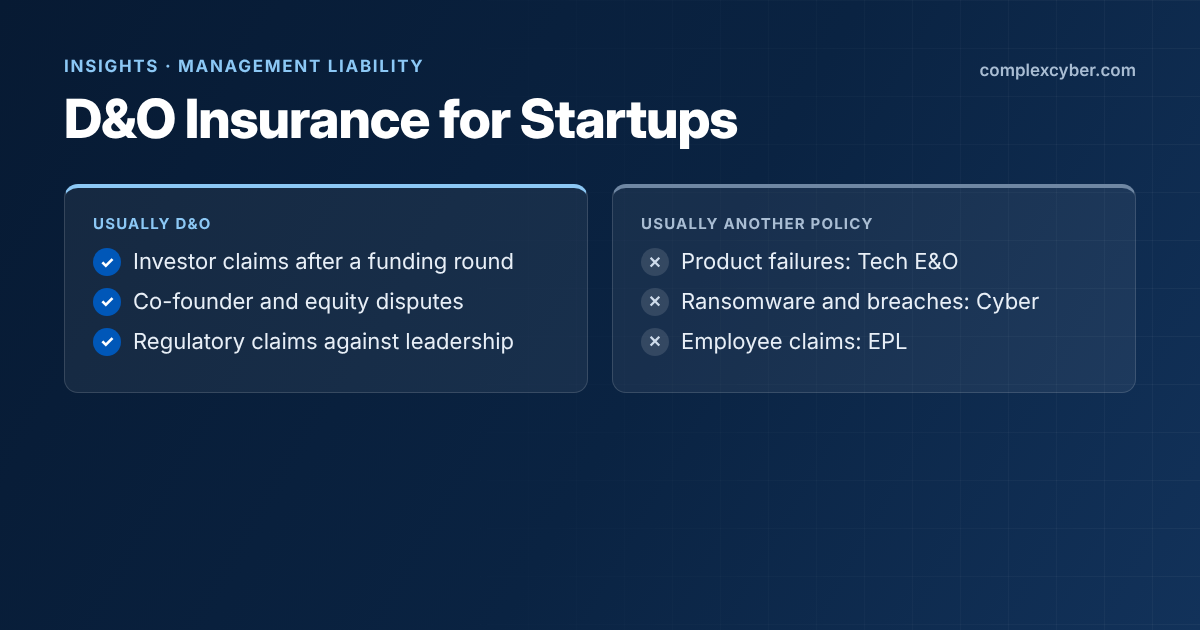
What D&O insurance covers
Directors and officers liability insurance pays defense costs, settlements, and judgments when someone claims the company’s leaders made a wrongful decision, misled someone, or breached their duties (see IRMI’s definition). Defense costs are often the biggest part of a claim, even when the allegations go nowhere.
Most private company policies have three parts:
| Coverage part | What it does | When it matters |
|---|---|---|
| Side A | Pays directors and officers directly when the company can’t indemnify them. | The company is out of cash, insolvent, or legally barred from paying. |
| Side B | Reimburses the company when it indemnifies its directors and officers. | Your bylaws or agreements require the company to cover its leaders’ defense. |
| Side C (entity) | Covers claims against the company itself. | Investors, competitors, or regulators sue the company along with its leaders. |
Who sues startup founders and directors
- Investors: claims that the company misrepresented its growth, technology, or finances while raising money, or that a down round or new financing treated them unfairly.
- Co-founders and former executives: disputes over equity, vesting, and decisions made after they left.
- Regulators: investigations into how the company raised money, marketed its products, or handled consumer issues.
- Competitors: unfair competition or trade practice claims, such as hiring a competitor’s team.
- Creditors and vendors: claims after a startup winds down or can’t pay its debts.
- Acquirers: claims after a sale that the company’s disclosures were inaccurate.
Overstating what your technology can do is a growing source of claims, especially around AI. Investors who feel misled about AI capabilities often look to D&O. Our guide to AI insurance covers how other policies respond to AI risks.
When startups need D&O insurance
There’s no single right moment, but these are the common triggers:
- Raising outside capital. Investors are a frequent source of claims, and many venture investors expect D&O to be in place before they join the board.
- Adding independent or investor directors. Experienced directors often won’t serve without it.
- Hiring employees. Employment claims are among the most common claims for growing companies, and they need employment practices liability (EPL), which is often packaged with D&O.
- Preparing for an acquisition or IPO. Coverage needs change before a deal, and buyers look closely at it.
D&O insurance for startups vs. cyber and Tech E&O
Founders sometimes assume D&O covers everything that can go wrong at the company. It doesn’t. Each policy has its own job:
| What happens | Policy that usually responds |
|---|---|
| Investors claim the board misled them during a funding round | D&O |
| A client claims your software failed and cost them money | Technology E&O; D&O usually excludes professional services |
| Ransomware shuts down your systems | Cyber |
| Shareholders claim the board ignored cyber risk before a breach | D&O, if the policy doesn’t exclude cyber-related claims |
| A former employee alleges wrongful termination | Employment practices liability (EPL) |
| An employee steals company funds | Crime |
Many startups buy D&O, EPL, fiduciary, and crime together as a management liability package, coordinated with cyber and Tech E&O so claims don’t fall between policies.
Exclusions to read carefully
- Professional services: claims about your product or services usually belong to Tech E&O, not D&O.
- Cyber and privacy: some D&O policies exclude claims connected to a breach, including shareholder claims about the board’s oversight.
- Insured vs. insured: claims by one insured against another, such as a co-founder suing the CEO, may be excluded unless the policy carves them out.
- Prior and pending litigation: disputes that started before the policy began usually aren’t covered.
- Fraud and illegal profit: usually excluded only after a final judgment, so defense costs are often paid until then.
How much D&O insurance a startup needs
Limits usually grow with the company. Early-stage startups often start with a modest limit, then increase it as they raise larger rounds, add directors, and approach an exit. Your investors, the size of your rounds, your board, and your industry all affect the right number. Remember that defense costs typically reduce the limit, so a long dispute can use up a small limit quickly.
What happens when you’re acquired
When a startup is sold, its D&O policy usually ends, but claims about decisions made before the sale can arrive years later. Deals commonly include run-off coverage, often for six years, which keeps protection in place for the former directors and officers. Plan for it early, because it’s usually bought at closing and the cost is part of the deal.
Check your coverage
Coverage Mapper
Map your services to the cyber, Tech E&O, and management liability coverage they call for, and see possible gaps.
Map your coverage →Cyber Insurance Application
Apply once for cyber and Tech E&O, and tell us you’d like D&O and management liability quoted alongside them.
Get quotes →Frequently asked questions
Do startups need D&O insurance?
Most startups that raise outside money or have an outside board do. Investors are a common source of claims, and many venture investors require D&O before they join the board. Very early companies without investors or a board may wait.
Does D&O insurance cover the company or just the directors?
Private company D&O policies usually cover both. Side A and Side B protect directors and officers, and entity coverage (Side C) protects the company when it’s sued alongside them.
Does D&O insurance cover a data breach?
D&O doesn’t pay breach response costs; that’s cyber insurance. It may cover claims that the board failed to oversee cyber risk, unless the policy excludes cyber-related claims.
Is D&O insurance for startups required by investors?
Often, yes. Venture term sheets commonly require the company to maintain D&O insurance, especially when an investor takes a board seat. Check your financing documents for the required terms.

Christine Marciano is the founder and president of Cyber Data Risk Managers LLC, an independent brokerage in Miami that has specialized in cyber and Technology E&O insurance since 2011. More about Christine
Raising a round or adding board members?
We’ll quote D&O insurance for startups alongside your cyber and Tech E&O, so your management liability and technology coverage fit together.
Request a Quote Start the ApplicationThis article is general information, not legal advice or a statement of coverage. Coverage depends on each policy’s terms, conditions, and endorsements. Review your financing documents and bylaws with your attorney.